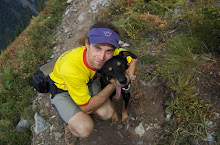
Oscar does not exactly hide his emotions. He makes it very easy to see what he wants by his behavior. And usually what he wants more than anything else is to go for a walk.
Oscar knows that mornings are for him: the first order of business each day is to go to the park for a vigorous workout. Pretty much every day starts this way and Oscar has come to expect this although that doesn't mean he won't try to get you out the door as early as possible.
Afternoons, however, are not always as kind to the Professor and most days end with only the one big morning walk. If it were up to Oscar we would go to the park three, four, five times a day but that's not practical for his owners for a number of reasons. But sometimes when I come home from a long day and I see how excited he gets I can't resist making him the happiest dog in the world and we go out for another ball session. When you see an animal (or a person) getting so excited at the prospect of a particular activity it just feels great being able to make that happen.
Conversely, it can break your heart not being able to come through all the time but I think we strike a good balance. Because if we don't go out in the afternoon then it's only a matter of hours until the next morning rolls around.
Sunday, November 1, 2009


Sunday, October 4, 2009
Lesson #33: Don't Just Vanquish Your Enemies, Disembowl Them
It should be no surprise to loyal readers of this blog that the Professor loves to chase balls and play with toys. My personal theory as to why he enjoys this so much is that a ball resembles a small furry animal that is simply begging to be chased. Oscar considers it his duty to conquer his plaything and stop all movement as quickly as possible. When the chase is over, McLovin often opts to take his victim into his mouth and thrash it about wildly from side to side.
 Just a few days ago he managed to separate the inner lining of his soccer ball from the outer shell and fling the ball from side to side as if it were a flaccid corpse. It was quite a display and it gave me the image that I tried to capture in the title of today's lesson.
 Just a few days ago he managed to separate the inner lining of his soccer ball from the outer shell and fling the ball from side to side as if it were a flaccid corpse. It was quite a display and it gave me the image that I tried to capture in the title of today's lesson.
Thursday, September 24, 2009
Beaches Are For Exploring
When Professor McLovin is outside he is usually quite excited. Some might say he becomes overstimulated by everything that's going around him and all those tempting options presented to him. On hikes he'll go crashing through the woods, blazing his own personal trail. In parks he'll run around among various landmarks, constantly checking out new things to play with.
 But on rocky beaches he never quite reaches that top gear. McLovin takes his sweet time to wander around the intertidal zone, exploring around rocks, checking out the water's edge, wistfully gazing at ducks just out of reach, all the while carefully avoiding those scary tidal pools. He doesn't tear around the beach like he does when he's in other outdoor environments--he has discovered that not everything should be glossed over as quickly as possible and that some things deserve a second look.

 But on rocky beaches he never quite reaches that top gear. McLovin takes his sweet time to wander around the intertidal zone, exploring around rocks, checking out the water's edge, wistfully gazing at ducks just out of reach, all the while carefully avoiding those scary tidal pools. He doesn't tear around the beach like he does when he's in other outdoor environments--he has discovered that not everything should be glossed over as quickly as possible and that some things deserve a second look.
Friday, September 18, 2009
Lesson #31: You Can Never Be Too Comfortable
We recently returned from a week-long vacation to our family's cabin on Hornby Island. The cabin is located directly on the beach which lends itself particularly well to certain activities of which the Professor is quite fond: aimless exploring, chasing birds and other small animals, fetching rocks out of the ocean, and just general romping about. In fact, it is a veritable Dog Heaven.

This doesn't mean McLovin won't for additional ways to make his visit more enjoyable. You might think he'd be content lazing about on the rocks with all of his whims satisfied for the duration of his stay. But he will definitely take advantage of a more comfortable resting place when given the opportunity, especially when it's unwittingly provided by one of his companions (see picture). I suppose one can always find ways to improve one's lot in life, even under seemingly ideal situations.

This doesn't mean McLovin won't for additional ways to make his visit more enjoyable. You might think he'd be content lazing about on the rocks with all of his whims satisfied for the duration of his stay. But he will definitely take advantage of a more comfortable resting place when given the opportunity, especially when it's unwittingly provided by one of his companions (see picture). I suppose one can always find ways to improve one's lot in life, even under seemingly ideal situations.
Sunday, September 13, 2009
Lesson #30: Don't Shy Away from Big Challenges
Professor McLovin loves playing with sticks. It took him a few months in our care to fully appreciate how much fun can be had with sticks but once he grew accustomed to this new type of plaything he quickly became open to all the intriguing and entertaining possibilities offered by a canine-arboreal combination.

When I pick out a stick for play, I go for something that is appropriately suited in such characteristics as length, girth, and weight so that Oscar can chase it at will. Buoyancy is an additional factor to be considered when throwing sticks into water.

However, when left to his own devices the Professor tends to throw common sense to the wind and opts for a very different kind of stick indeed: his mantra seems to be longer, bigger, heavier, more unwieldy. The pictures show the kind of stick that he likes to pick up on his own accord. You can judge for yourself whether you would choose a stick of this size when other options were available.

And yet he's never disappointed or frustrated by having to deal with a larger-than-necessary problem. If he can physically move it then he will figure out how. If he needs to work on it for hours in order to chew it in half then just give him enough time to get the task done. The Professor doesn't shy away from big challenges--let that be the lesson we learn from him today.

When I pick out a stick for play, I go for something that is appropriately suited in such characteristics as length, girth, and weight so that Oscar can chase it at will. Buoyancy is an additional factor to be considered when throwing sticks into water.

However, when left to his own devices the Professor tends to throw common sense to the wind and opts for a very different kind of stick indeed: his mantra seems to be longer, bigger, heavier, more unwieldy. The pictures show the kind of stick that he likes to pick up on his own accord. You can judge for yourself whether you would choose a stick of this size when other options were available.

And yet he's never disappointed or frustrated by having to deal with a larger-than-necessary problem. If he can physically move it then he will figure out how. If he needs to work on it for hours in order to chew it in half then just give him enough time to get the task done. The Professor doesn't shy away from big challenges--let that be the lesson we learn from him today.
Thursday, September 3, 2009
Lesson #29: It's the Thought That Counts
As detailed previously in this blog, Professor McLovin howls when he hears sirens in the distance. Sometimes, however, he is so overcome by his need to join in that he completely forgets about his current situation and breaks out into song regardless of what he might doing. This includes times when there is something already in his mouth.
This afternoon we were at the park--the Professor just made another one of his Willie Mays catches look routine--when an ambulance drives by. Oscar, of course, feels the need to join the chorus so he puts his head back and lets loose with a howl. What comes out is not his typical mournful cry: rather, he emits garbled sounds of nonsense that sound more like a muted trumpet played underneath an elevated train. The Professor doesn't seem to notice or care that his call to his brethren was not as sonorous as usual but what's important is that he gave his best effort to sing along and didn't waste time dropping his ball in order to do so.
This afternoon we were at the park--the Professor just made another one of his Willie Mays catches look routine--when an ambulance drives by. Oscar, of course, feels the need to join the chorus so he puts his head back and lets loose with a howl. What comes out is not his typical mournful cry: rather, he emits garbled sounds of nonsense that sound more like a muted trumpet played underneath an elevated train. The Professor doesn't seem to notice or care that his call to his brethren was not as sonorous as usual but what's important is that he gave his best effort to sing along and didn't waste time dropping his ball in order to do so.
Monday, August 31, 2009
Lesson #28: Willie Mays Wasn't That Special
My dedicated readers have no doubt noticed that there have not been many postings on this blog of late. That is because the Professor generally takes summer off from teaching to spend more time on his research projects. I realize these breaks are frustrating but I think we should consider ourselves lucky to have access to such a luminary figure on a regular basis throughout the school year that we should not begrudge his summer vacation.
But the Professor is back on the dais which brings us to today's lesson delivered during the heart of baseball season.

It's known in most circles simply as "The Catch". Willie Mays made an outstanding play in the 1954 World Series by chasing down a fly ball hit over his head and catching it on the fly. Many people think it is the best defensive play in the history of baseball.
Oscar McLovin is here to tell you that we shouldn't get so carried away by Mays's dramatic display. The Professor performs this same feat at least once a day during our ball-throwing session. Let's compare the human to the canine:
- Mays catches the ball on the fly whereas McLovin allows it to bounce once or twice. Advantage: Mays
- Mays needs special equipment to catch a ball whereas McLovin doesn't. Advantage: McLovin
- Mays made his catch in a pressure-packed situation whereas McLovin doesn't know what pressure is. Advantage: Mays
- Mays caught his ball with his hands (a part of the body ideally designed to perform such tasks) whereas McLovin catches balls with his mouth. Advantage: McLovin
- Mays had to wait for the ball to be hit to take off whereas McLovin generally anticipates where the ball is going to be, taking off before the ball is thrown his way. Advantage: Tie
- Mays made his catch once in his lifetime whereas McLovin makes the catch routinely. Advantage: McLovin
I'll let you decide which version of "The Catch" is more impressive but the spectator wins wither way as each one is fun to watch.
But the Professor is back on the dais which brings us to today's lesson delivered during the heart of baseball season.

It's known in most circles simply as "The Catch". Willie Mays made an outstanding play in the 1954 World Series by chasing down a fly ball hit over his head and catching it on the fly. Many people think it is the best defensive play in the history of baseball.
Oscar McLovin is here to tell you that we shouldn't get so carried away by Mays's dramatic display. The Professor performs this same feat at least once a day during our ball-throwing session. Let's compare the human to the canine:
- Mays catches the ball on the fly whereas McLovin allows it to bounce once or twice. Advantage: Mays
- Mays needs special equipment to catch a ball whereas McLovin doesn't. Advantage: McLovin
- Mays made his catch in a pressure-packed situation whereas McLovin doesn't know what pressure is. Advantage: Mays
- Mays caught his ball with his hands (a part of the body ideally designed to perform such tasks) whereas McLovin catches balls with his mouth. Advantage: McLovin
- Mays had to wait for the ball to be hit to take off whereas McLovin generally anticipates where the ball is going to be, taking off before the ball is thrown his way. Advantage: Tie
- Mays made his catch once in his lifetime whereas McLovin makes the catch routinely. Advantage: McLovin
I'll let you decide which version of "The Catch" is more impressive but the spectator wins wither way as each one is fun to watch.
Subscribe to:
Posts (Atom)